
Best Hangboards for Finger Strength Training 2026: Ranked
Best overall: Tension Grindstone Mk2 Hangboard. Best for beginners: Metolius Project Hangboard. Best budget option: Muscle Mountain MegaEdge Portable Hangboard. This guide ranks six hangboards for finger strength training in 2026, each matched to a distinct setup: beginner, advanced, portable, no-drill and budget.
- Tension Grindstone Mk2 is the best hangboard overall for structured finger strength training at home in 2026.
- Metolius Project Hangboard is the best hangboard for beginners — it ships with a mounting kit and a simpler grip layout.
- Muscle Mountain MegaEdge Portable Hangboard is the best budget hangboard, packing 10mm to 35mm edges into a travel-sized block.
- YY Vertical VerticalBase is the best no-drill hangboard for renters who can't fix a board to the wall.
- Tension The Pod is the best portable hangboard for crag-bag warm-ups at 107 grams.
Why this matters
Finger strength is the biggest limiter past 6a/V3, and a hangboard is the only tool that isolates it without the rest of your climbing movement getting in the way. The Escapades stocks hangboards from Tension, YY Vertical, Metolius, Lattice and Muscle Mountain International, and the right pick in 2026 depends on your wall, your grade and how much space you've got to mount one.
Browse the full training range at The Escapades before committing to a hangboard that won't actually fit your doorframe or your training plan.
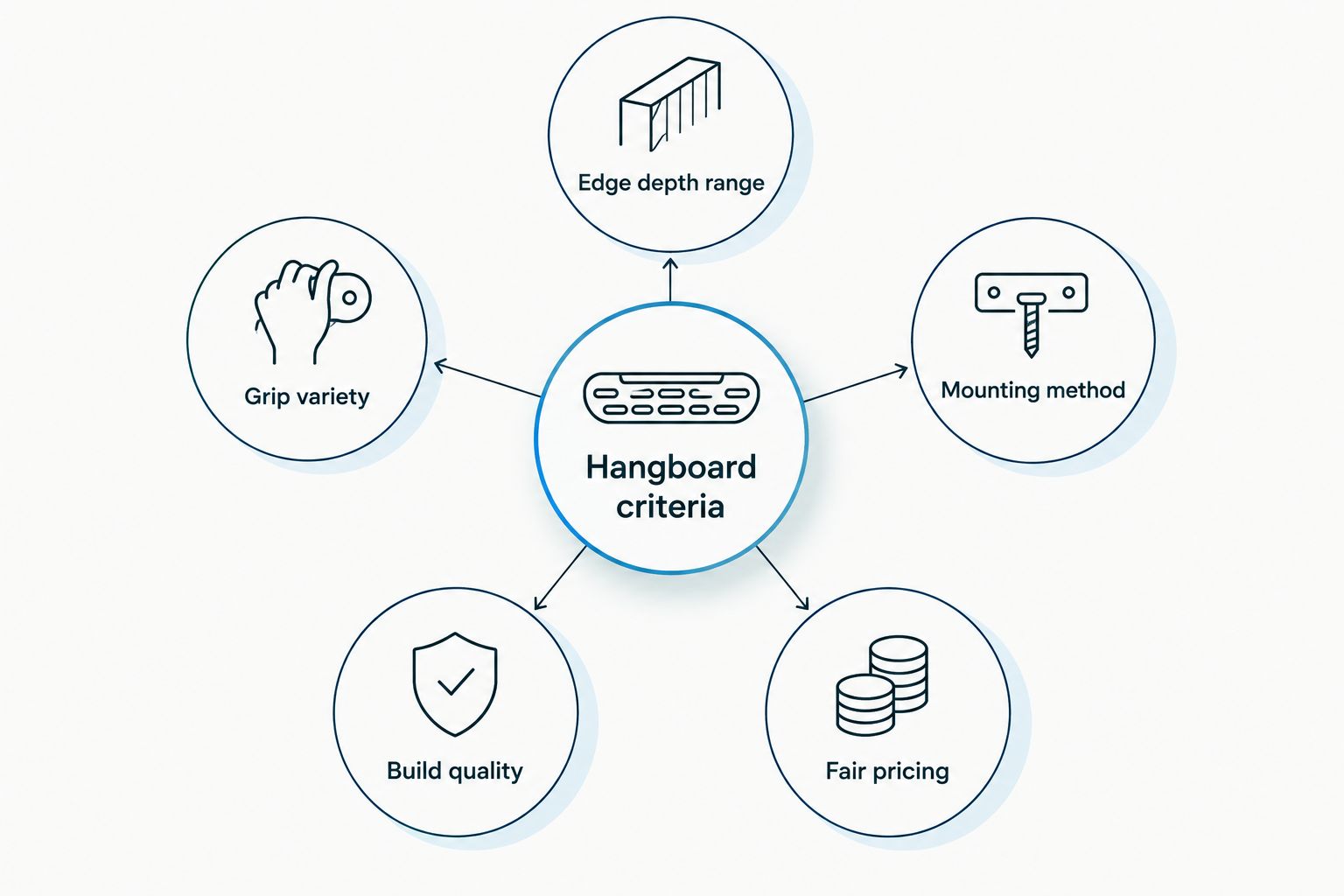
What makes the best hangboard
- Edge depth range — a board with one or two edge sizes limits your training once you're past the beginner stage.
- Grip variety — crimps, slopers, pockets and pinches target different tendon and pulley demands, not just crimp strength.
- Board material and edge shape — wood is gentler on skin over long sessions than resin, and edge radius changes how a 20mm edge actually feels.
- Mounting method — fixed frame, no-drill door mount, or portable rope-hang decides where and how often you'll actually use it.
- Build for repeated max hangs — a board used for max hangs and repeaters needs to survive months of full bodyweight loading without flexing.
- Fair pricing for the training you get — a board with three edges shouldn't cost the same as one with fifteen.
Hangboards at a glance
| Hangboard | Best for | Standout feature | Key limitation |
|---|---|---|---|
| Tension Grindstone Mk2 | Structured home training | 8mm to 50mm edge range in one board | Needs a solid fixed mount, not portable |
| YY Vertical Board Evo | Advanced grip variety | 19 grip positions including monos and slopers | Overkill under a few months of hangboarding |
| Metolius Project Hangboard | Beginners | Ships with a mounting kit | Fewer edges once you progress |
| Tension The Pod | Portable warm-ups | 107g with three edge depths | Too small for full sessions |
| YY Vertical VerticalBase | No-drill mounting | Full training station, no drilling into the frame | Bulkier than a wall-mounted board |
| Muscle Mountain MegaEdge Portable | Budget option | 10mm to 35mm edges plus three pinches | Edges sit close for bigger hands |
1. Tension Grindstone Mk2 Hangboard: best hangboard for structured home training
The Grindstone Mk2 is a single-piece wooden fingerboard covering 8mm to 50mm edges, built for a progressive training plan rather than one workout.
Tension Grindstone Mk2 pros:
- Widest edge range in this list, covering beginner to advanced hangs
- Wood is kinder on skin than resin across repeated sessions
- Single-piece construction holds up to max hangs
Tension Grindstone Mk2 cons:
- Needs a proper fixed mount, not a no-drill setup
- No travel option if you also want something portable
- Takes up permanent wall space once fitted
Best for: climbers with a home wall who want one board that lasts years of progress. Verdict: Buy.
2. YY Vertical Board Evo: best hangboard for advanced grip variety
This poplar wood board packs 19 grips, including monos, pockets, slopers and micro edges, aimed at climbers who've moved past a base fingerboard.
YY Vertical Board Evo pros:
- Broadest grip variety of any board on this list
- Separates crimp, sloper and pocket training on one board
- Poplar wood construction holds up to repeated sessions
YY Vertical Board Evo cons:
- Too much board for a first year of hangboarding
- Monos and small pockets carry real injury risk without existing finger strength
- Needs a dedicated mount, same as the Grindstone
Best for: climbers already comfortable on a 20mm edge who want to isolate slopers and pockets. Verdict: Buy for advanced training, Skip if this is your first board.
3. Metolius Project Hangboard: best hangboard for beginners
A compact fingerboard that ships with a mounting kit, built as a first board for climbers starting structured training rather than adding it to a workout by feel.
Metolius Project Hangboard pros:
- Mounting kit removes the guesswork of fitting a board
- Simpler grip layout doesn't overwhelm a first-timer
- Fairly priced for an entry-level fingerboard
Metolius Project Hangboard cons:
- Fewer edge depths than the advanced boards above
- Most climbers outgrow it within a year or two of consistent training
- Limited grip variety once the basics are covered
Best for: anyone who hasn't trained on a fingerboard before. Verdict: Buy.
4. Tension The Pod: best hangboard for portable warm-ups
A 107g portable warm-up board with a contoured top jug plus 20mm, 12mm and 8mm edges, small enough to live in a crag bag permanently.
Tension The Pod pros:
- Light enough to carry to every session in 2026 and beyond
- Three edge depths cover a real warm-up progression
- Small enough to clip to a harness or stash in a chalk bag
Tension The Pod cons:
- Not built for max hangs or a full strength programme
- Only three edges, which limits structured training
- Needs somewhere to hang from at the crag
Best for: warming up before you climb, alongside a full-size board at home. Verdict: Buy as a warm-up tool, not a main board.
5. YY Vertical VerticalBase: best hangboard for no-drill mounting
A no-drill mounting system that turns a standard door frame into a complete no-drill door frame hangboard mount and training station, adjustable to fit most doorways.
YY Vertical VerticalBase pros:
- Solves the rented-flat problem entirely
- Adjustable fit works across most standard door frames
- Turns any doorway into a repeatable training spot
YY Vertical VerticalBase cons:
- Bulkier and pricier than a simple wall-mounted board
- Still needs a doorway with clearance either side
- Overkill if you already own a wall you can drill into
Best for: renters or climbers who can't put screws in a wall but still want a proper hangboard station. Verdict: Buy.
6. Muscle Mountain MegaEdge Portable Hangboard: best budget hangboard
A dense travel fingerboard packing edges from 10mm to 35mm plus three pinches into one compact block.
Muscle Mountain MegaEdge Portable pros:
- Widest edge range for the price point in this list
- Pinches add a grip type most portable boards skip
- Compact enough for a gym bag or car boot
Muscle Mountain MegaEdge Portable cons:
- Edges sit close together, which feels cramped for bigger hands
- Basic construction compared with the premium boards above
- No dedicated mounting kit included
Best for: edge-range training on a tight budget. Verdict: Buy.


How we ranked
Every board above was judged against the six criteria: edge depth range, grip variety, material and edge shape, mounting method, build quality under repeated loading, and fair pricing for what you get. Two other boards nearly made the cut. The YY Vertical Board Evo sits at the advanced end with 19 grip positions, while the YY Vertical VerticalBoard One offers 15 grips on a magnetic insert system for climbers between the Project and the Evo. Tension's The Block packs crimps, pinches and pockets into one portable slab if The Pod feels too limited. Neither of those two displaced the six ranked above, because each already covers that gap for less complexity.
“If you can't hold a 10-second hang on a 20mm edge, you need more time on the wall before you need a fingerboard.”
Which hangboard should you choose?
Buy the Tension Grindstone Mk2 Hangboard if you have a wall to mount it on and want one board that covers years of progress. Go with the Metolius Project Hangboard if this is your first fingerboard in 2026. Renters without drilling rights want the YY Vertical VerticalBase. Everyone benefits from a Tension The Pod for warm-ups, whichever main board you buy.
FAQ
What is the best hangboard for beginners in 2026?
The Metolius Project Hangboard is the best hangboard for beginners in 2026. It ships with a mounting kit and a simpler grip layout that doesn't overwhelm a first-time trainer.
Is a hangboard better than a campus board for finger strength?
A hangboard builds isolated finger strength through static hangs, which is the base you need before a campus board makes sense. Campus boards add power and contact strength on top of that base, not instead of it.
How much edge depth do I need on a hangboard?
Most structured protocols train mainly on a 20mm edge, which every board in this guide includes. Move to smaller edges only once 20mm hangs feel controlled rather than desperate.
Can I use a hangboard without drilling into a wall?
Yes. No-drill door frame mounts like the YY Vertical VerticalBase turn a standard doorway into a training station without any fixings into the frame.
How often should I train on a hangboard?
Most hangboard protocols run two to three sessions a week with rest days between them, since finger tendons recover more slowly than muscle.
What's the difference between a portable hangboard and a full-size board?
A portable hangboard like the Tension The Pod is built for quick warm-ups at the crag, at 107g with three edge depths. A full-size board like the Tension Grindstone Mk2 covers a complete structured programme.
Do wooden or resin hangboards feel different on the skin?
Wood is generally gentler on the fingertips over repeated sessions, while resin edges can feel sharper and wear skin faster over a training block.
Is the YY Vertical Board Evo suitable for beginners?
No. Its 19 grips include monos and micro edges that carry real injury risk without an existing base of finger strength, so it suits advanced climbers, not first-time hangboard users.
One last thing
The beginner mistake isn't picking the wrong board, it's picking the wrong edge on the right one. Structured hangboard protocols are built around the 20mm edge for a reason: it's the depth every board in this list includes, and it's deep enough that you're testing finger strength, not grip endurance on a knife-edge crimp. Start there on whichever board you choose in 2026, and only move to smaller edges once 20mm hangs feel controlled.
Related guides
- Rhino Skin Repair for patching torn fingertips after high-volume hangboard sessions
- Metolius Magnum Crash Pad for topping out projects once your fingers catch up to your climbing


